// Service
Legacy code maintenance, reverse engineering & modernization
Careful changes, reverse engineering and step-by-step modernization for the Delphi, Oracle PL/SQL and Java systems that still run your business.
Last updated:
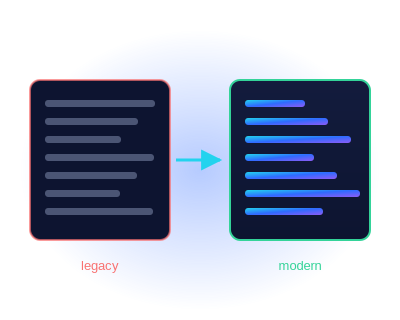
Keep the systems that run your business, and make them better
Many companies depend on software written ten or twenty years ago: Delphi desktop applications, Oracle databases full of PL/SQL business logic, Oracle Forms, older Java applications. They still work, but every change feels risky and the original developers have moved on. We take over that code, make careful changes, and modernize it step by step instead of betting the business on a full rewrite.
- DelphiMaintenance and new features, newer compiler and component versions, database access updates, and migration paths.
- Oracle PL/SQL & FormsPackages, procedures and triggers; fixes, new business rules, performance tuning, and moving Forms logic to web applications.
- JavaOlder Java applications moved to a current LTS release, library and security updates, build modernization.
- IntegrationsConnecting legacy systems to new ones through files, databases and APIs, including automated, monitored file transfers.
Reverse engineering legacy systems into modern stacks
When documentation is missing and nobody remembers why the system behaves as it does, we reconstruct it from the source: code, database schema, stored procedures, reports, configuration and observed behaviour. The result is a written specification and automated tests that capture the real business rules. With those, the system can be rebuilt in modern languages and frameworks (for example Java/Spring, Python, TypeScript web front-ends, REST APIs on PostgreSQL or Oracle) without losing knowledge that exists only in the old code.
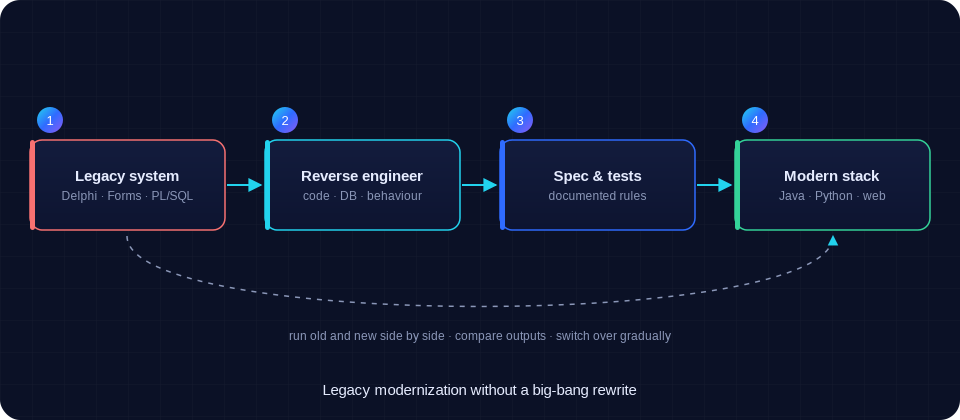
- Code and data archaeology: dependency maps, call graphs, data flows and a glossary of business terms.
- Characterization tests: tests that record what the old system does today, so the new one can be proven equivalent.
- AI-assisted analysis: private, local AI tools to speed up reading large codebases, with an engineer verifying every conclusion. Your code never leaves your control.
- Strangler approach: replace one module or screen at a time behind a stable interface, keeping the business running.
Maintain, modernize or migrate
- Assess: read the code, database and build process; document how it works and where the risks are.
- Stabilize: reproducible builds, version control, fixes for urgent bugs and security issues.
- Modernize step by step: improve or replace one part at a time, each step deployable and tested.
- Migrate only where it pays off: when a rewrite is right, plan it module by module with old and new side by side.
Does the old system exchange data as files? Emona MFT picks up exported files from a folder and delivers them reliably, without new integration code in the legacy application.
Frequently asked questions
Can you work on code without documentation or the original developers?
Yes. That is the typical situation. We reverse engineer the code, database and behaviour, and leave you with documentation you did not have before.
Should we rewrite our legacy application from scratch?
Rarely all at once. A full rewrite is risky and expensive. We usually recommend stabilizing first, then replacing parts step by step, so value arrives early and risk stays low.
Which modern languages and frameworks do you migrate to?
Whatever fits your team and environment, commonly Java (Spring Boot), Python, web front-ends in TypeScript, and REST APIs on PostgreSQL or Oracle Database.
Do you use AI to analyse our code?
Only if you agree, and only with local models running on infrastructure you control. AI speeds up reading; an engineer checks every result.